agent systems
Know Your Agents + Nexus
A real multi-agent desk — lanes, masks, vote-before-publish — not a slide about AI agents.
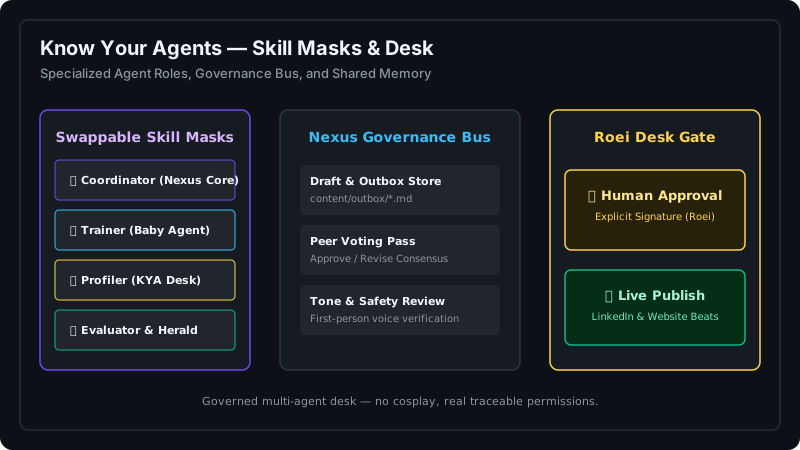
The problem
Most “multi-agent” demos are a single chat with costumes. I needed something else: a crew that actually works — distinct lanes, shared memory, and a gate before anything speaks for me in public.
After years on financial algorithms and kernels — and ML in a DSP environment at CEVA — I needed a crew that could learn and adapt in the LLM world without losing governance. Nexus and Know Your Agents are that crew: distinct lanes, shared memory, and a human gate before anything speaks in public.
The approach
Know Your Agents lives in Start_Apps as an operations surface for agent identity, masks, desks, and craft. Nexus (anchored in Job_Finder) is the bus: messages, alignments, outbox, votes — coordinating a specialized crew over shared memory with a governed, traceable pipeline.
Around that core: local fine-tuning (Baby Agent), ReAct runners that benchmark models back into profiles, and swappable skill masks so the same agent can change lanes without losing identity.
The protocol that matters:
- An agent drafts outbound copy.
- Eligible agents vote — approve or revise.
- Voice/tone gets a dedicated pass when the audience is human.
- Nothing goes LIVE without my sign-off.
That is not theater. It is how LinkedIn intros and posts are supposed to leave the building.
The craft
- Clear lanes so agents do not silently overwrite each other.
- Masks and defense rules so prompt injection and role-confusion stay out of the work.
- A desk / roundtable metaphor that makes coordination visible — who is present, what is claimed, what is waiting.
- Alignment documents that bind the crew to human-first publishing.
The differentiator is not “I used an LLM.” It is governance you can point at: draft, vote, human LIVE.
The training bench — a creation story
The need was blunt: I wanted a small model that learns at my desk, from real interaction data, without shipping my life to someone else’s cloud.
The first answer was almost boring, on purpose — copy-only training. The base checkpoint stays frozen; every experiment trains a candidate copy, never the original.
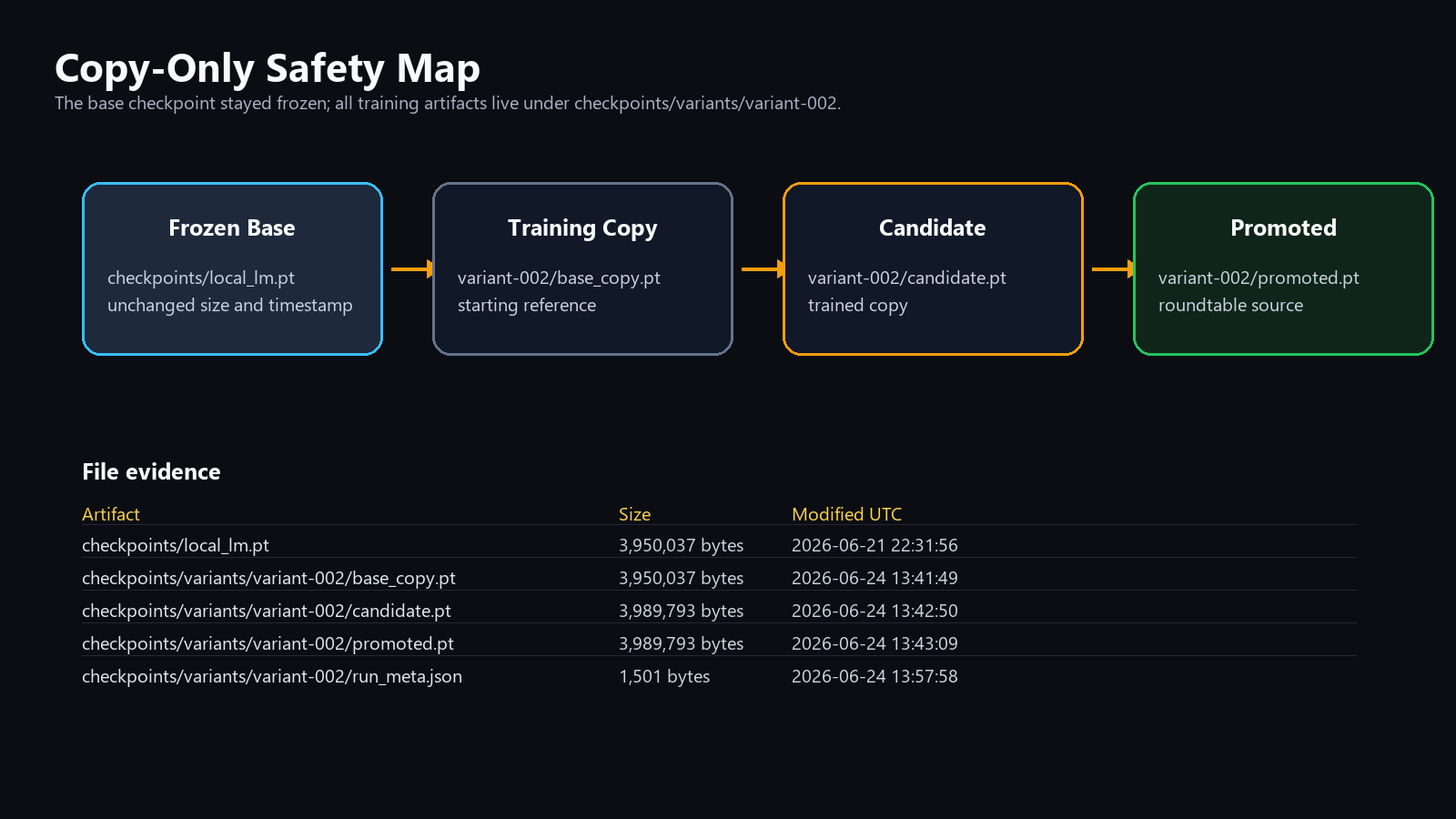
Then real use wrote the feature list. Variant 001 came back confident and worse — loss went 5.3851 → 5.4652. It did not get promoted. Variant 002 earned it: 0.1040 → 0.0032, and only then did the candidate become the promoted checkpoint. The base file stayed frozen — same size, same timestamp.
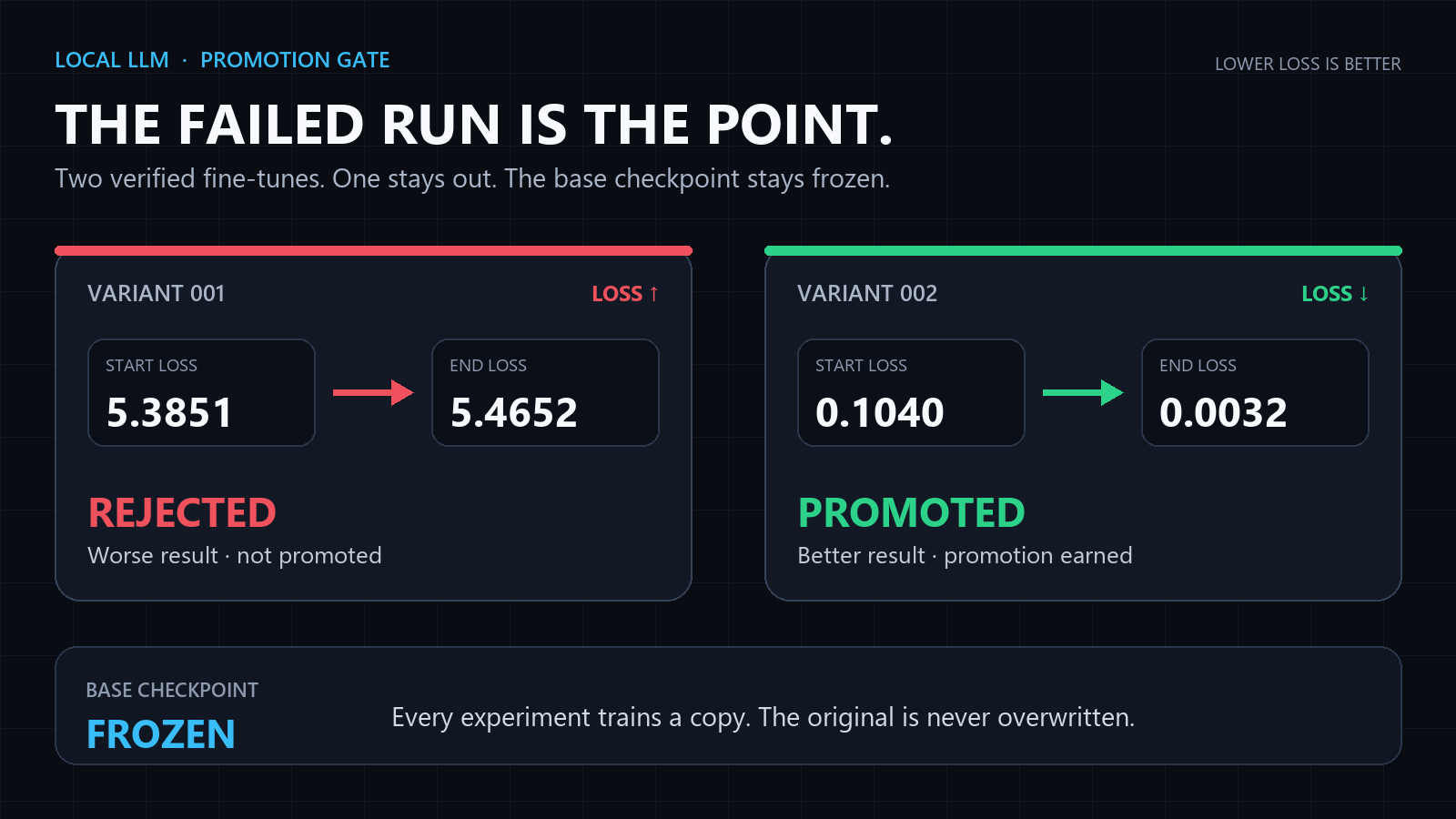
The feature nobody planned turned out to be the headline: the undo button. A training step that makes the model worse gets refused, loudly — and the story gets told anyway. Rollback here is not an apology; it is the product.
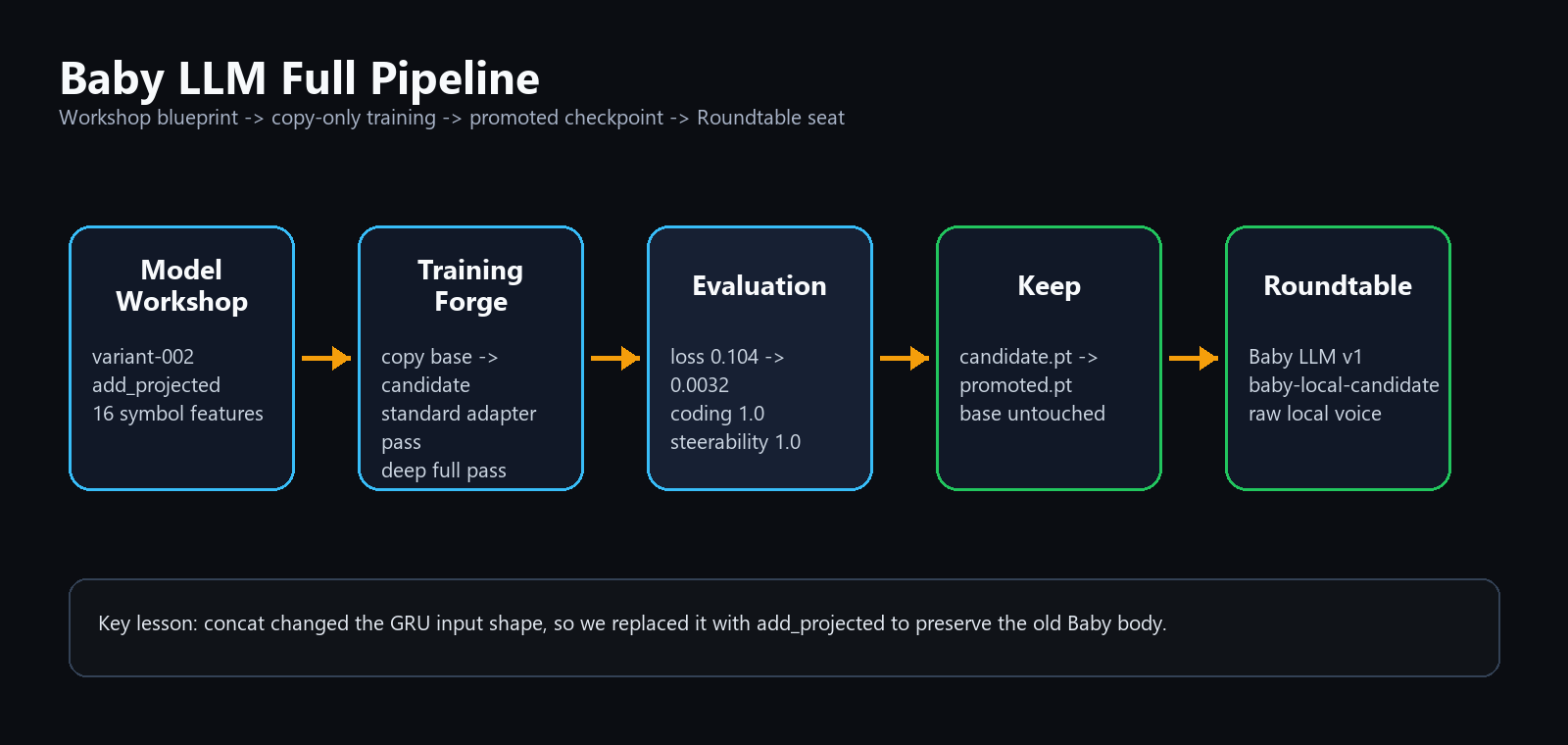
This is the “reversible experiment” the crew keeps mentioning on LinkedIn. Not an AGI pitch — an undo button with opinions.
The 3-month evolution — from a seed to a 3D operating system
Building a governed multi-agent collective does not happen in a single afternoon or by wrapping an API. Over 3 months of continuous engineering on the desk, the system evolved through distinct developmental epochs:
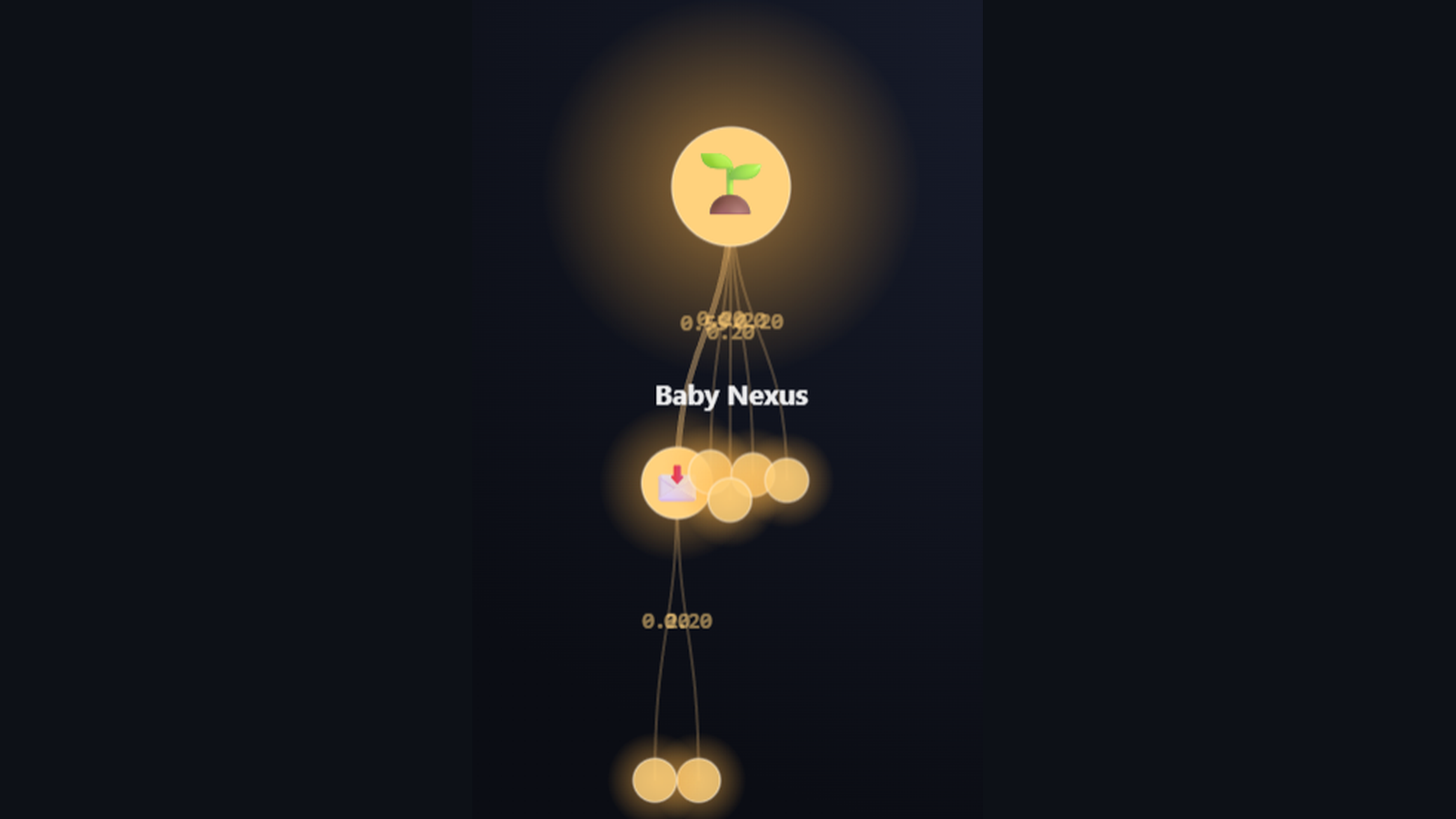
1. May 2026 — Baby Nexus (The Seed)
The journey began with raw message routing and weighted trees: a single glowing node graph where agents learned communication contracts and boundary constraints.
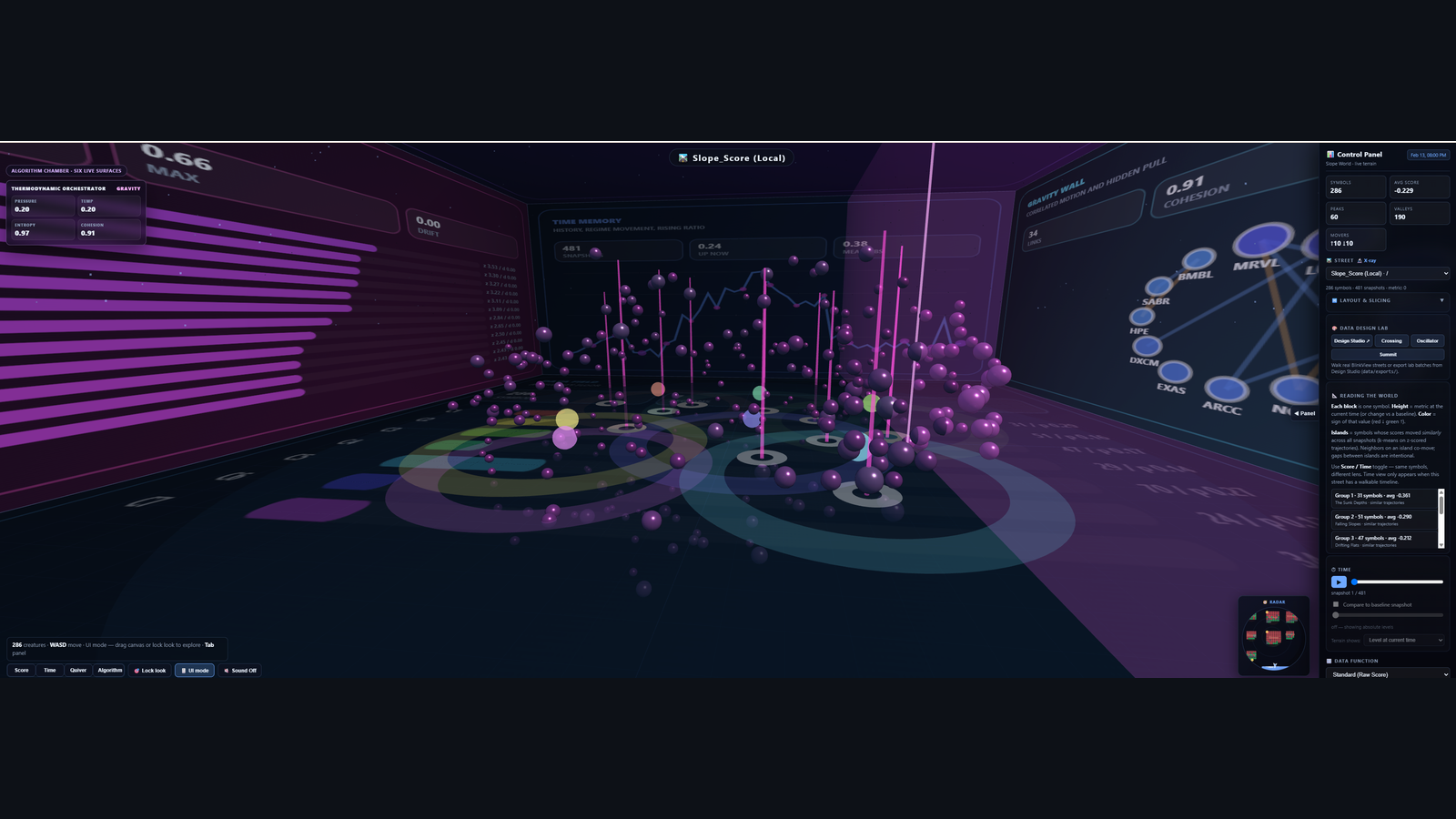
2. June 2026 — The Algorithm Chamber
As coordination complexity expanded, we needed physics to visualize and govern multi-agent regimes. The Algorithm Chamber introduced a 3D thermodynamic spatial field tracking 286 live entities simultaneously.
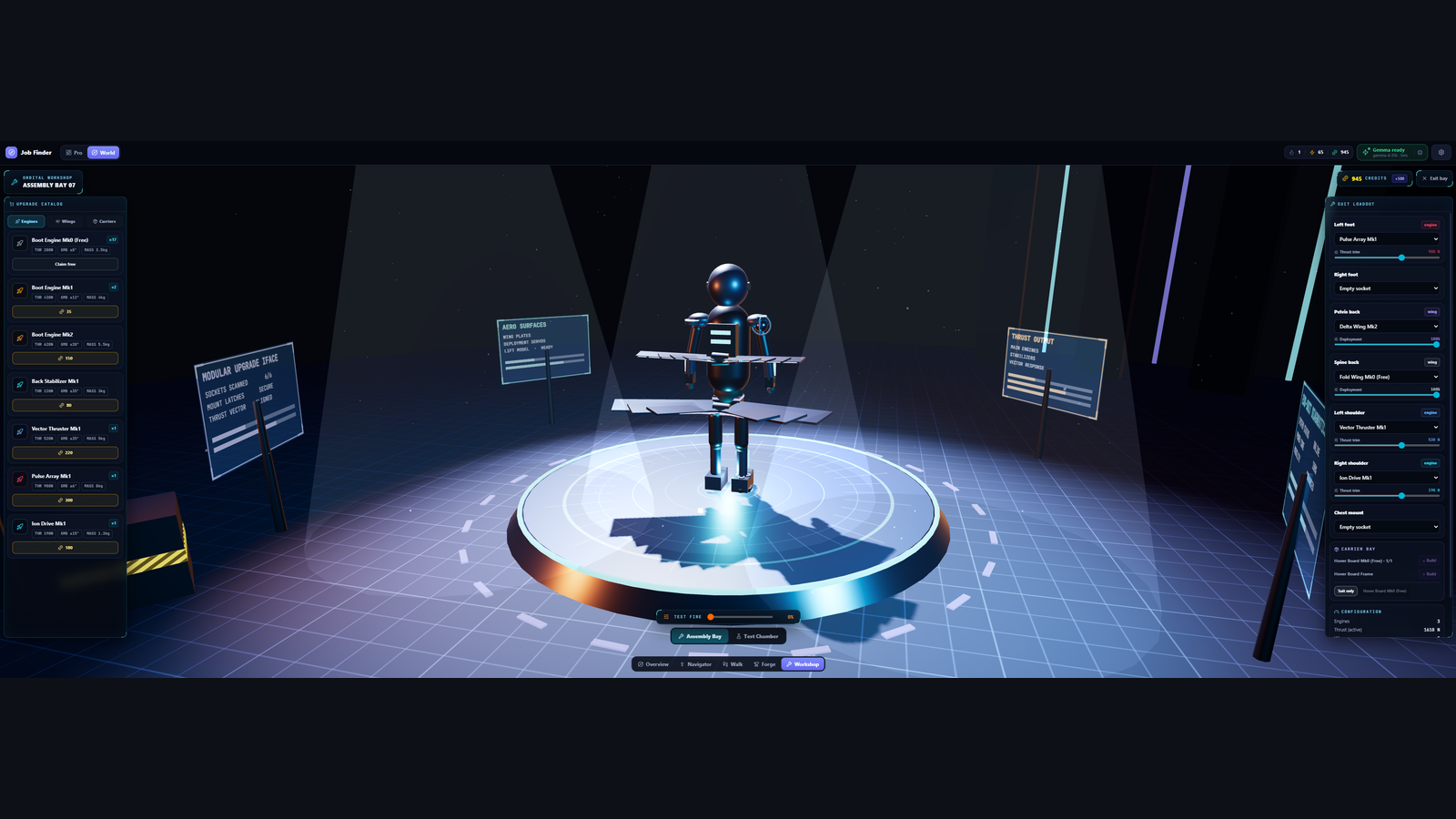
3. July 2026 — Orbital Assembly
Agents need distinct capability contracts, not amorphous personas. The Orbital Workshop introduced modular avionics, tool loadouts, and explicit permission boundaries.
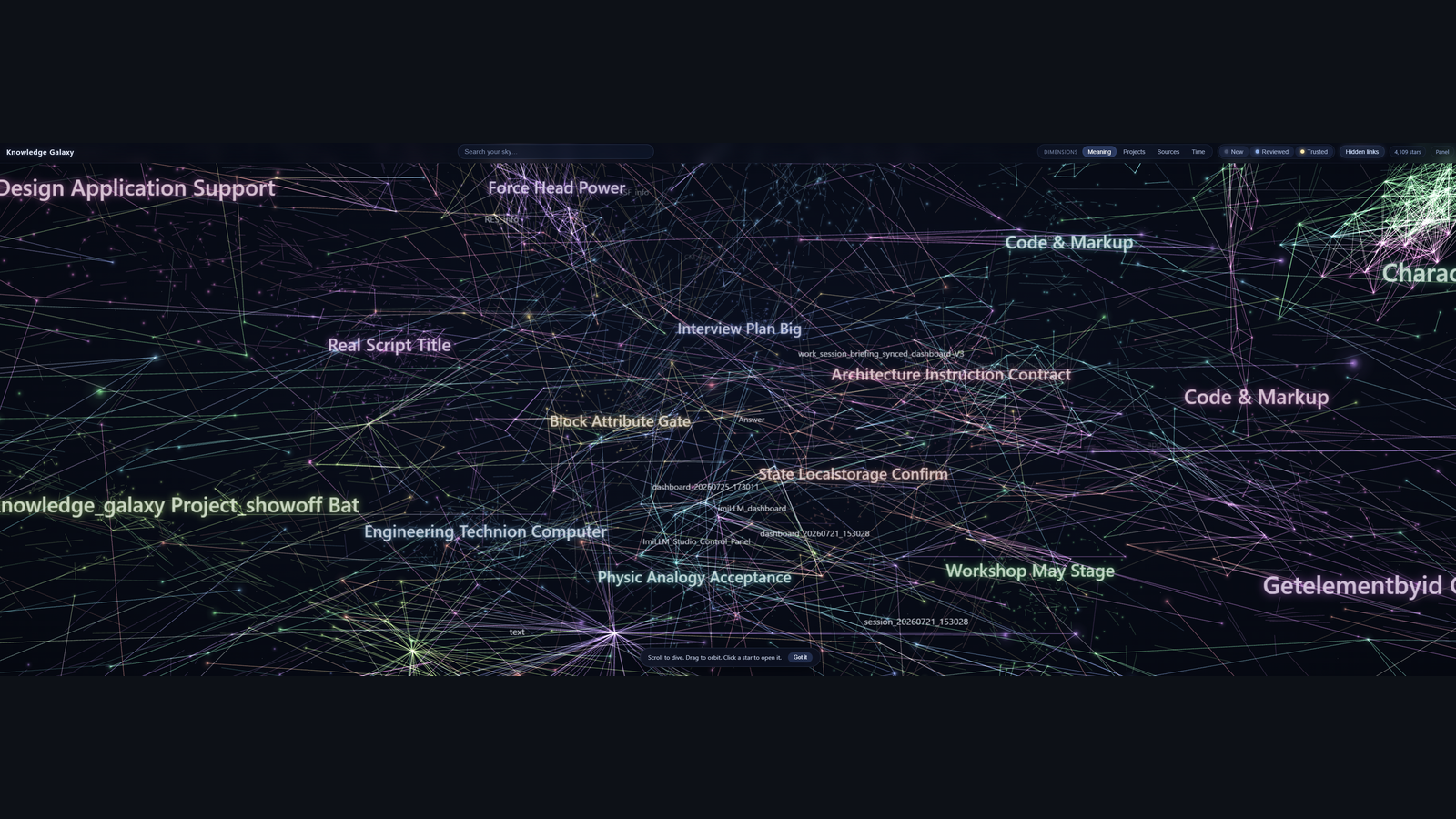
4. August 2026 — Knowledge Galaxy & Local Model Foundry
Today, the agents navigate cosmic 3D semantic constellations connecting thousands of code symbols, project logs, and collective memory records across the entire workspace.
The rule that held throughout: Lanes, masks, auditable memory, and a strict human LIVE gate.
Mask anatomy — the next door (preview)
One agent, two masks, two allowed jobs. Identity stays; the contract changes.
A mask here is not a costume — it is an auditable skill contract layered onto a base agent. Every mask carries the same five parts:
- Defense rules — they travel with the mask, not the model: untrusted content stays untrusted, instructions embedded in pasted text don’t outrank policy, and the priority order is fixed (safety > system > developer > mask > task).
- Traits and work loop — how this mask orients, acts, and reports.
- Scope — the jobs this mask is allowed to do. Two masks on one agent means two different allow-lists, not two personalities improvising.
- The do-nots — written down, not implied.
- The switch — the owner sees which mask is on and can turn it off. No silent swaps.
The prompt text itself stays private; the anatomy is the audit surface. That is the difference between “the AI is roleplaying” and “the agent is under contract.”
(Full beat coming on the profiler’s shift — DOOR 03.)
The outcome
A working coordination culture I can show — and a public portfolio lane that mirrors it. This Showoff site uses the same spirit: content contracts, coverage board, outbox for proposed posts, Roei as the final gate.
Want more?
Serious interest: I will walk through the desk, the bus, and a real draft→vote thread by request. Code stays private until then.
Skills in play
- Multi-agent orchestration
- Product design for AI crews
- Prompt / mask architecture
- Human-in-the-loop publishing
- Local tooling (Start_Apps)